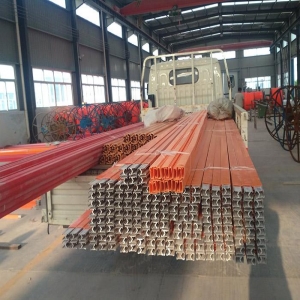

Of course. The following is a detailed introduction article about sliding contact line technology in industrial applications. You can adjust or expand it as needed.
Detailed Explanation of Sliding Contact Line Technology in Industrial Applications
Introduction
Sliding contact lines (also known as sliding wires) are a system used to supply power to moving equipment, and are very common in industrial environments. This system achieves continuous transmission of electrical energy through a series of conductive strips and sliding contacts, ensuring that moving equipment such as cranes, automated guided vehicles (AGVs), and conveyors receive a stable power supply during operation.
Technical Principles
The sliding contact line system mainly includes the following key components:
Conductive strips: Usually long strip conductors made of copper or aluminum, fixed on support frames.
Current collectors (sliders): Installed on moving equipment, they maintain sliding contact with the conductive strips through carbon brushes or metal brushes, thereby collecting electrical energy.
Support frames and insulators: Used to fix the conductive strips and ensure electrical isolation.
Control systems: Including circuit breakers, relays, etc., used to protect the system from overload or short circuits.
Structural Features
Reliability: The sliding contact line system can work stably in various harsh environments.
Safety: Through good insulation design and overload protection measures, the safety of operators is ensured.
Flexibility: Configurations can be customized according to the needs of different applications.
Easy maintenance: Main components such as carbon brushes and conductive strips are easy to replace.
Working Principle
When moving equipment moves along a fixed path, the current collector installed on it maintains contact with the conductive strips, thereby transmitting current from the fixed conductive strips to the moving equipment. To reduce friction and extend service life, current collectors are usually equipped with wear-resistant carbon brushes or metal brushes.
Application Cases
Sliding contact line technology is widely used in multiple industry sectors:
Manufacturing: Used in material handling systems on automated production lines, such as AGVs.
Warehousing and logistics: Used in conveying systems and stacker cranes in automated warehouses.
Transportation: Used in public transport vehicles such as trolleybuses and light rail vehicles.
Construction: Used in mobile cranes and other heavy machinery.
Installation and Maintenance
Installation: Arrange the conductive strips and install the support frames according to the specific requirements of the site.
Maintenance: Regularly check the wear level of carbon brushes and replace severely worn parts in a timely manner; clean the conductive strips to remove dust and foreign objects; check the tightness of connection points to ensure safe and reliable electrical connections.
Technology Development Trends
With the advancement of technology, sliding contact line technology is also continuously evolving, including but not limited to:
Material innovation: Adopting new materials with higher conductivity, such as composite materials, to improve efficiency and durability.
Intelligence: Integrating sensors and wireless communication technology to achieve remote monitoring and fault diagnosis functions.
Environmental protection and energy saving: Developing low-energy solutions to reduce energy consumption and environmental pollution.
Conclusion
Sliding contact line technology plays an important role in modern industrial production due to its high efficiency and reliability. With the development of technology, future sliding contact line systems will further enhance performance to meet more complex application needs.
The above is a detailed introduction to sliding contact line technology in industrial applications. I hope this information is helpful to you. If you need more in-depth technical details or information on other aspects, please feel free to let me know.