
Certainly. Below is an overview article about sliding contact line technology in industrial applications. You can adjust or expand it according to your actual needs.
Detailed Explanation of Sliding Contact Line Technology in Industrial Applications
Overview
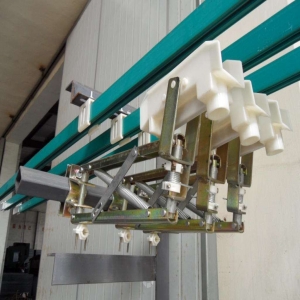
Sliding contact line (also known as sliding wire) is a device used to supply power to moving equipment (such as cranes, transport vehicles on automated production lines, etc.). It transmits electrical energy from a fixed conductor to the moving equipment through a set of sliding contacts, ensuring continuous power supply during the movement of the equipment.
Principle and Structure
The sliding contact line system typically includes the following main components:
Conductive bars: Fixedly installed on support frames, serving as carriers for electrical energy transmission.
Current collectors: Installed on moving equipment, with carbon brushes or metal brushes maintaining contact with the conductive bars to collect electrical energy.
Support frames and insulators: Used to fix the conductive bars and ensure electrical isolation.
Control and protection devices: Ensure the safe operation of the system.
Advantages
High reliability: Can stably supply power to moving equipment.
Easy maintenance: Only requires regular replacement of worn carbon brushes.
Strong adaptability: Suitable for various industrial environments and conditions.
Flexibility: Layout and length can be adjusted as needed.
Application Scenarios
Sliding contact lines are widely used in various industrial fields:
Cranes: Bridge cranes, gantry cranes, etc.
Logistics and warehousing: Automated guided vehicles (AGVs), conveyor systems, etc.
Manufacturing: Assembly lines, test benches, etc.
Public transportation: Trolleybuses, light rail vehicles, etc.
Installation and Maintenance
Installation: Before installation, detailed planning of the site is required, including the layout of conductive bars, positions of support frames, etc.
Maintenance: Regularly check the wear of carbon brushes and replace them in a timely manner; clean dust and impurities on the conductive bars; check the tightening of current collectors.
Development Trends
With technological advancements, sliding contact lines are also continuously developing and improving, such as adopting new materials to enhance conductivity and durability, integrating intelligent monitoring systems for remote management and fault diagnosis, etc.
The above is a brief introduction to sliding contact line technology. I hope this information is helpful to you. If you need more detailed technical specifications or information on specific application scenarios, please let me know your further requirements.