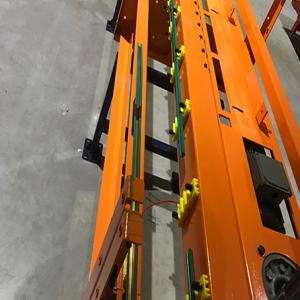

Sliding contact wire is a device used for power transmission, commonly found on mobile equipment such as cranes and electric tool carts, to provide continuous power supply. This article will explore the working principle, characteristics, and applications of sliding contact wire in different fields.
Working Principle of Sliding Contact Wire
Sliding contact wire mainly consists of a fixed track (slide wire) and a sliding contactor (slider). The slide wire is installed in a fixed position, usually laid along the movement path of the equipment; while the sliding contactor is installed on the mobile equipment, maintaining contact with the slide wire as the equipment moves, thereby achieving continuous power transmission.
Characteristics of Sliding Contact Wire
Continuous Power Supply: Provides uninterrupted power supply to mobile equipment.
Flexibility: Suitable for various mobile equipment, the length and layout of the slide wire can be adjusted as needed.
Safety: Uses insulating materials to reduce the risk of electric shock.
Easy Maintenance: Simple structure, easy to maintain and replace parts.
Applications of Sliding Contact Wire
Hoisting Machinery: Used on cranes to provide power, ensuring continuous operation during movement.
Electric Tool Carts: Used for power supply to electric tool carts, allowing them to move freely in warehouses or production lines.
Public Transportation: In tram and light rail systems, sliding contact wire provides power to vehicles.
Industrial Automation: In automated production lines, provides power to mobile robots and conveyor systems.
Considerations for Selecting Sliding Contact Wire
Load Requirements: Choose the appropriate slide wire specification based on the power requirements of the mobile equipment.
Movement Range: Consider the maximum movement range of the equipment to determine the length and layout of the slide wire.
Environmental Conditions: Choose slide wire materials that can adapt to specific environmental conditions (such as humidity, temperature, etc.).
Safety: Ensure the slide wire has good insulation performance to reduce safety hazards.
Steps for Using Sliding Contact Wire
Plan Layout:
Plan the routing of the slide wire according to the movement trajectory of the mobile equipment.
Determine the installation position and support structure of the slide wire.
Install Slide Wire:
Install the slide wire according to the planned route.
Ensure the slide wire is installed firmly and straight.
Connect Power Supply:
Connect the slide wire to the power source to ensure stable power supply.
Check the safety and reliability of the connection points.
Install Sliding Contactor:
Install the sliding contactor on the mobile equipment.
Adjust the position of the contactor to ensure good contact with the slide wire.
Test Operation:
Start the mobile equipment to test the performance of the sliding contact wire system.
Observe the equipment operation to ensure continuous and stable power supply.
Maintenance:
Regularly check the wear of the slide wire and contactor.
Clean the slide wire surface to remove dust and debris.
Conclusion
As a key component in power transmission, sliding contact wire plays an important role in hoisting machinery, electric tool carts, and public transportation. By selecting and using sliding contact wire reasonably,