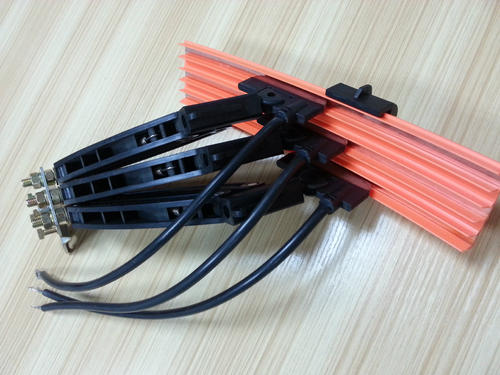

When a fault occurs on the busbar in a double-bus configuration, attention should be paid to the operating mode of the busbar protection during fault handling, and if necessary, the busbar protection should be temporarily taken out of service.
After the busbar voltage completely disappears, the dispatcher should immediately open all switches that may supply power (including the bus coupler switch), and notify the operation team to conduct an external inspection of the busbar.
When the busbar trunking system loses voltage due to a fault and there are obvious signs of short circuit (such as fire, explosion sound, smoke, etc.), the operation team personnel must not restore operation on their own; instead, they should conduct a detailed inspection of the busbar equipment.
If a component connected to the busbar fails or a branch circuit breaker refuses to operate, causing a cascade trip and loss of voltage on the busbar, a detailed inspection should be conducted. Immediately isolate the faulty component of the busbar trunking system or open the disconnecting switches on both sides of the faulty branch circuit breaker, then quickly restore busbar operation and supply power to other branches.
1. Air busbar trunking system specifications
1. Low-voltage three-phase four-wire busbar trunking system specifications: 250A, 400A, 630A, 800A, 1000A, 1250A, 1600A, 2000A, 2500A, 3150A, 4000A, 5000A, 6300A
2. Low-voltage three-phase five-wire busbar trunking system specifications: 250A, 400A, 630A, 800A, 1000A, 1250A, 1600A, 2000A, 2500A, 3150A, 4000A, 5000A, 6300A.
3. High-voltage busbar trunking system specifications: 6kV and 10kV, current ratings: 400A, 630A, 800A, 1000A, 1350A, 1600A, 2000A, 2500A.
2. Compact busbar trunking system specifications
1. Low-voltage three-phase four-wire busbar trunking system specifications: 250A, 400A, 630A, 800A, 1000A, 1250A, 1600A, 2000A, 2500A, 3150A, 4000A, 5000A, 6300A
2. Low-voltage three-phase five-wire busbar trunking system specifications: 250A, 400A, 630A, 800A, 1000A, 1250A, 1600A, 2000A, 2500A, 3150A, 4000A, 5000A, 6300A.
3. High-voltage busbar trunking system specifications: 6kV and 10kV, current ratings: 400A, 630A, 800A, 1000A, 1350A, 1600A, 2000A, 2500A.
Generally speaking, busbar trunking systems are mainly used for power transmission. We know that all conductors have losses, and the losses generated when current flows through conductors vary; some are larger, some are smaller. For example, compared with aluminum conductors of the same cross-section, aluminum has higher losses, while copper has lower losses. That is, the conductivity is different. Copper has relatively high conductivity. We also know that the larger the cross-sectional area of copper, the more electricity it can transmit. Household wires are copper wires wrapped in an insulating outer layer. Since household electricity requirements are not very large, ordinary copper wires can provide electricity for everyone. If it is a large workshop, the current may need several thousand amperes. Then, the current that this copper wire can provide is far from sufficient. At this time, copper busbars come into play, because copper busbars have a larger cross-sectional area and can carry more current. When the copper busbar is covered with a protective shell, it becomes the basic prototype of a busbar trunking system. Now, you understand the function of busbar trunking systems, right? That is, they can provide larger currents as needed, up to 6300A.
In addition, besides providing large currents, the structure of the busbar trunking system itself makes it very convenient to draw power from the busbar. You only need to use a plug-in box to plug into the tap-off port of the busbar trunking system. Busbar trunking systems are divided into air plug-in busbar trunking systems and compact plug-in busbar trunking systems, and both have three-phase four-wire and three-phase five-wire versions.