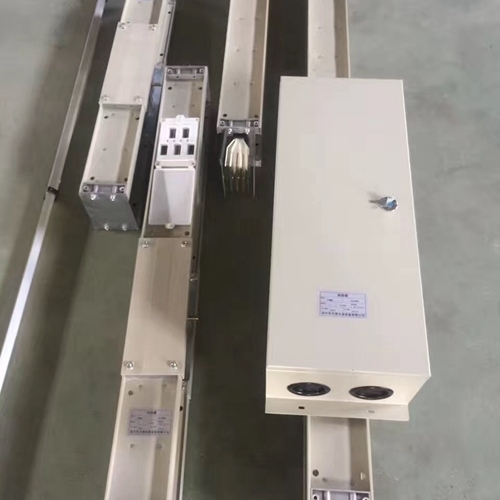

The working principle and characteristics of the sliding contact line current collector:
Working principle:
Sliding contact line: composed of multiple parallel metal guide rails, each rail represents a phase or neutral line.
Current collector (collector trolley): installed on mobile equipment, its collector brush maintains sliding contact with the sliding contact line, thereby achieving power transmission.
Collector brush: usually made of materials with good conductivity and wear resistance, such as graphite or copper alloy, to ensure reliable electrical connection.
Characteristics:
Reliability: stable power supply even in harsh environments.
Flexibility: suitable for various mobile equipment and can adapt to complex travel paths.
Safety: uses insulating materials and technologies to reduce the risk of electric shock.
Easy maintenance: collector brushes are easy to replace after wear.
Wide applicability: not only suitable for indoor environments but also for outdoor environments.
Application scenarios:
Industrial cranes: used for heavy material handling.
Automated storage and retrieval systems: automatically transporting goods in logistics centers.
Port handling equipment: such as quay cranes, gantry cranes, etc.
Public transportation systems: such as trams, light rail vehicles, etc.
Technical specifications:
Voltage level: can be low voltage (such as 380V) or high voltage depending on application requirements.
Current capacity: depends on the requirements of the driven equipment, ranging from tens of amperes to thousands of amperes.
Environmental adaptability: factors such as dustproof, waterproof, and corrosion resistance need to be considered.
If you need specific model information, manufacturer details, or technical specifications, please provide more specific requirements, and I will do my best to find relevant information for you.