

Darui Electric recommends for you
Modern high-rise buildings and large workshops require huge amounts of electrical energy, and to handle the hundreds or thousands of amperes of strong current needed for such heavy loads, safe and reliable conduction equipment must be selected. The busway system is an excellent choice. It is a power distribution device for transmitting current, especially suitable for the economic and reasonable wiring needs of increasingly tall buildings and large-scale factories.
Due to the electrical needs of various buildings such as high-rise buildings and factories, and the trend of these needs increasing year by year, using the original circuit wiring method, i.e., the conduit method, brings many difficulties during construction. Moreover, when it is necessary to change the power distribution system, making it simpler is almost impossible. However, if a busway is adopted, this goal can be achieved very easily, and it can also make the building more aesthetically pleasing.
Busway conductors, whether copper or aluminum alloy, have a service life that critically depends on the operating temperature rise; the higher the operating temperature rise, the faster the aging rate (including copper, aluminum bars, and insulating materials. The creep strength, oxidation rate, and tensile strength of the copper and aluminum alloys used for conductors are closely related to the temperature rise). Due to different designs, structures, and heat dissipation, the internal temperature rise also varies.
According to the design manual's ambient temperature of 35°C, a well-ventilated compact busway should have its current-carrying capacity reduced by 5%-15% to meet the ≤70K temperature rise value. For compact busways with poor heat dissipation, the reduction should be about 20%, and for air-type busways, the reduction in current-carrying capacity should be even greater.
Industry applications:
1. Application in high-rise buildings:
Generally, the building design will provide installation space (shaft) for the busway, connecting directly from the distribution cabinet to the busway. Each floor is equipped with one or more plug-in switch boxes, and then power is distributed from these switch boxes to various electrical equipment and circuits via cables or wires. Connecting the busway to cable distribution boxes and then supplying power to each floor from these boxes, using the busway as a socket, does not demonstrate the advantages of the busway, and such a power supply method is not recommended.
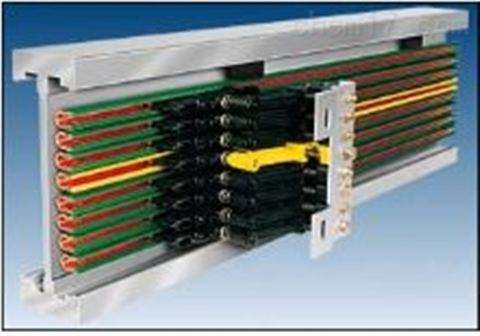
Plug-in busways belong to the trunk-type system, with advantages such as small size, compact structure, reliable operation, large current transmission capacity, easy tap-off power feeding, convenient maintenance, low energy consumption, and good dynamic and thermal stability, making them widely used in high-rise buildings.
Note: The above information and technical parameters are compiled and released by Yangzhou Darui Electric Co., Ltd.