Single-Pole Combined Busbar
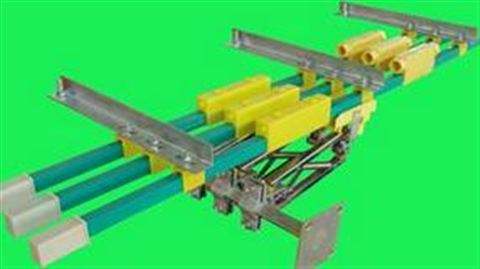
The single-pole combined busbar HXPnR-H, HXPnR-H8, and HXPnR-H thickened seriessingle-pole busbar for three-phase, four-wire, and five-wire systems is composed of an H-shaped aluminum alloy main body rail, a pressed V-shaped stainless steel sliding strip, a PVC insulating shell, external current collectors, and suspension and fixing components. The single-pole combined busbar product is widely used in occasions with large currents, high usage frequency, fast operation speeds, and poor environments due to its novel design, reasonable structure, easy maintenance, anti-corrosion and dust-proof performance, and safe use.
Accessories for single-pole combined busbar
Single-Pole Busbar
The JDC-H type, single-pole conductor busbar is made of rare earth aluminum alloy, with large current-carrying capacity and small voltage drop. At the friction parts between the aluminum conductive surface and the brush, wear-resistant stainless steel inserts are used to ensure reliable moving conduction and effective service life. It is widely used for mobile power supply of various large-tonnage gantry cranes, bridge cranes, loading and unloading cranes, container cranes, and other mechanical equipment.
Introduction to Single-Pole Combined Busbar
The HXPnR-H type protective safety busbar has a conductive main body of "H"-shaped aluminum profile, hence it is also called "H"-type energy-saving sliding wire device. Energy saving is relative to busbars with angle steel as the main body, as the loss of electrical energy during transmission is greatly reduced. The resistivity of aluminum is much lower than that of steel, and its specific gravity is small. Rolling aluminum into an "H" shape improves overall rigidity and strength while ensuring a certain conductive cross-sectional area. However, the surface hardness of aluminum is low and it is not wear-resistant. To make the aluminum substrate practical as a conductive busbar, the "H"-shaped middle beam is made into an arched shape, and wear-resistant stainless steel profiles are embedded at this position according to specified process procedures. This "H"-shaped stainless steel profile serves as the friction and conduction surface for the conductive blocks in the current collector. The embedding process ensures tight combination of stainless steel and aluminum profile, so that the current introduced from the aluminum profile passes through the stainless steel body and is transmitted out through the friction contact with the conductive blocks in the current collector, ensuring continuous current during the operation of the crane.
The conductive busbar is protected along its longitudinal direction by ABS plastic as a whole, except for the lower opening where it contacts the current collector. Therefore, after installation, there is no exposed conductive part of the contact line, which brings great convenience to installation and maintenance. At the same time, the overall plastic shell protection (except for the opening) prevents dust accumulation and provides protection against rain, dew, ice, and snow. The connection between rails is made by a dedicated rail connector that allows both the rail and the plastic shell to be inserted together, and the connection end is also safe and reliable.
Current collector: It is spring-supported and can be pushed in from the lower part of the busbar, but it must be synchronized with the tractor, and the tension of the tension spring should be appropriate to avoid increasing brush wear. The tractor and current collector move synchronously and can be fixed to the traveling crane or other mobile equipment by bolts or welding, ensuring that the current collector is not subjected to torsional forces during operation.
Selection Instructions