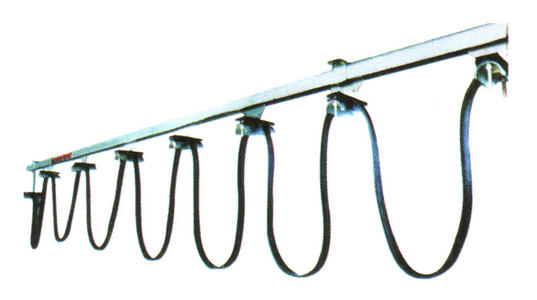
Double-head current collector mainly consists of components such as the brush shoe, brush box, spring, current collector bracket, and current collector support part. Current collectors are divided into heavy-duty and light-duty types. The choice between a light-duty and heavy-duty current collector is determined by the current of the sliding contact line. Generally, if the sliding contact line current is less than or equal to 500A, a light-duty current collector can be selected; if it is greater than 500A, a heavy-duty current collector should be used.
When selecting a double-head current collector, *the first consideration is to choose a manufacturer that matches the sliding contact line. Do not use current collectors indiscriminately, as this may affect the normal operation of the crane, and in severe cases, may burn out the sliding contact line. The brush shoe on the current collector is made of copper-carbon based material pressed together. After purchase, check its fit with the sliding line. Since the current collector itself is a consumable item, long-term use will wear the brush shoe, so it is necessary to regularly inspect the wear level of the brush shoe on the current collector and replace it periodically.
It is the main device for picking up electrical energy on the collector side in the sliding contact line system. It directly conducts electrical energy to the electrical equipment through the sliding contact between the collector brush and the guide rail, thereby achieving mobile power supply for the system. It consists of two parts: the tension device of the mechanical structure and the collector brush that directly slides in contact with the guide rail. Also known as current receiver, power receiver, conductor, etc. Available in multi-pole, single-pole, single-pole row type, and combined type sliding line current collectors. (Industry: sliding contact line, sliding line, sliding conductor, sliding mobile power transmission and supply)
The current collector is one of the most important components in the sliding line system.
The current collector is the main device for picking up electrical energy on the collector side in the sliding contact line system. It directly conducts electrical energy to the electrical equipment through the sliding contact between the collector brush and the guide rail, thereby achieving mobile power supply for the system. The current collector consists of two parts: the tension device of the mechanical structure and the collector brush that directly slides in contact with the guide rail.
The tension device of the mechanical structure determines the sliding contact pressure between the collector brush and the guide rail and the stability of the mechanism. The collector brush is the conductor that picks up electrical energy through sliding contact with the guide rail. Its performance, conductive quality, and the quality of material structure and composition will directly affect the safe operation quality of the entire system equipment.
Product Introduction:
The current collector is one of the main devices for picking up electrical energy on the collector side in the sliding contact line system. It directly conducts electrical energy to the electrical equipment through the sliding contact between the collector brush and the guide rail, thereby achieving mobile power supply for the system. The current collector consists of two parts: the tension device of the mechanical structure and the collector brush that directly slides in contact with the guide rail. The tension device of the mechanical structure determines the sliding contact pressure between the collector brush and the guide rail and the stability of the mechanism. The collector brush is the conductor that picks up electrical energy through sliding contact with the guide rail. Its performance, conductive quality, and the quality of material structure and composition will directly affect the safe operation quality of the entire system equipment. Therefore, the current collector is one of the most important components in the entire sliding line system.