Multi-level Busbar Trolley Collector
Busbar trolley collector (carbon brush|electric brush) is the main device on the collection side of the busbar system that picks up electrical energy. It directly conducts electrical energy to the electrical equipment through the sliding contact between the collector brush and the guide rail, thereby achieving mobile power supply for the system. The busbar trolley collector consists of two parts: a mechanical tension device and a collector brush that directly slides in contact with the guide rail. Busbar trolley collector, current collector, power supply device, conductor device. Multi-pole busbar trolley collector, single-pole busbar trolley collector, single-pole row-type busbar trolley collector, combined busbar trolley collector. (Industry: busbar, sliding wire, sliding conductor, sliding contact mobile power transmission and supply)
Single-pole busbar trolley collector, 200A 360 collector, 500A collector, 500A 360 collector, 500A plastic-sprayed stainless steel, 1250A collector, 1600A collector, 500A single-arm collector, 2000A collector, 100A collector, 80A C-type collector, 68A C-type double-rod collector, 800A collector WH, steel body sliding wire double-head collector, steel body sliding wire single-head collector, 500A collector figure-8 type. Single-pole busbar trolley collector
Multi-level Busbar Trolley Collector
(1) Product Overview:
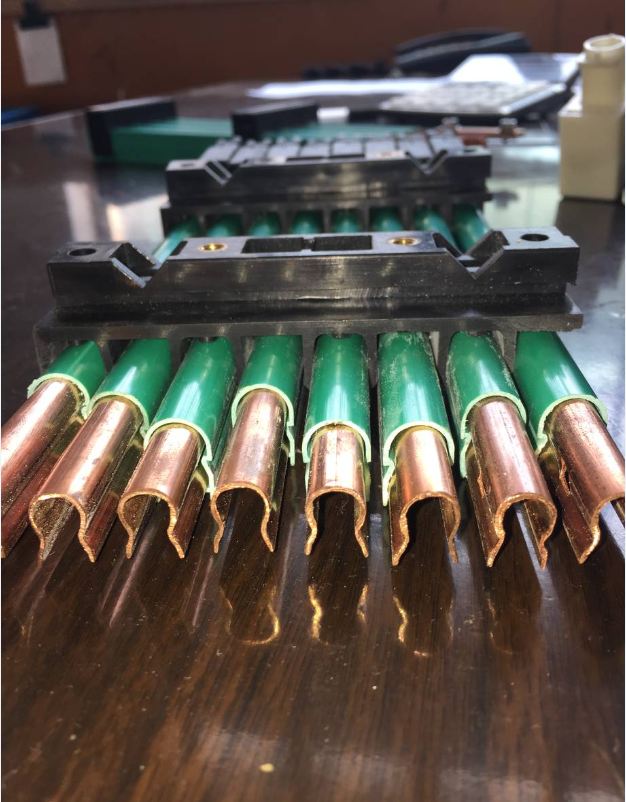
The tubular multi-pole safety busbar adopts a high-molecular PVC shell, with multiple copper conductors embedded as power transmission busbars, and is equipped with a flexible multi-pole brush collector. Its structure is simple and compact, safe and reliable, and easy to install and maintain.
The multi-pole busbar uses copper instead of steel as the power transmission conductor, which can save 15% to 20% of electrical energy, and greatly saves materials and installation costs.
It is now widely used in hoisting machinery in factories, mines, warehouses, stations, ports and docks, such as electric hoists, beam and bridge cranes, elevators, automated production lines, and other mobile electrical equipment.
(1) Product Models and Technical Parameters:
| No. | Model Specification |
Conductor Cross-sectional Area mm2 |
Rated Current |
DC Resistance Ω/KM |
Rated Current Impedance Ω/KM |
| 1 | DMHP(J)—3—10/50 | 10 | 50 | 1.8 | 1.91 |
| 2 | DMHP(J)—3—140/400 | 140 | 400 | 0.128 | 0.14 |
| 3 | DMHP(J)—4—10/50 | 10 | 50 | 1.8 | 1.91 |
| 4 | DMHP(J)—4—16/80 | 16 | 80 | 1.157 | 1.16 |
| 5 | DMHP(J)—4—25/120 | 25 | 120 | 0.71 | 0.725 |
| 6 | DMHP(J)—4—35/140 | 35 | 140 | 0.51 | 0.526 |
| 7 | DMHP(J)—4—50/170 | 50 | 170 | 0.36 | 0.385 |
| 8 | DMHP(J)—4—70/210 | 70 | 210 | 0.26 | 0.287 |
| 9 | DMHP(J)—4—95/270 | 95 | 270 | 0.21 | 0.225 |
| 10 | DMHP(J)—4—120/320 | 120 | 320 | 0.16 | 0.174 |
| 11 | DMHP(J)—4—150/360 | 150 | 360 | 0.11 | 0.128 |
| 12 | DMHP(J)—6—10/50 | 10 | 50 | 1.8 | 1.91 |
(2) Technical Performance and Safety Indicators of Multi-pole Busbar: