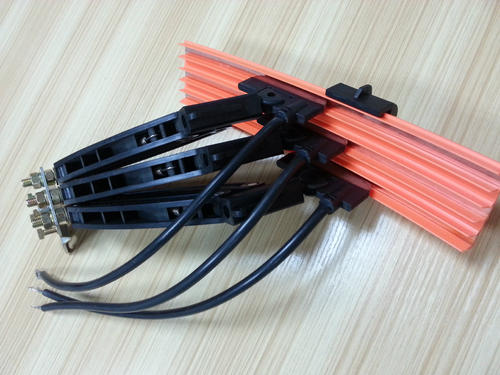
Current Collector is Sliding Wire
There are many types of current collectors, and those commonly used in testing include: wire-pull type, brush type, and inductive type, etc. The first two are contact-type current collectors, while the latter is a non-contact type.
Wire-pull type current collector
The structural principle of the wire-pull type current collector is shown in the right figure.
Wire-pull type current collector
A bakelite inner ring 2 is fixed on the circular shaft 1, and a collector ring 3 is embedded in its groove, connected to the strain gauges attached to the shaft; thus, electrical signals are transmitted from the collector ring 3, through the pull wire 4, insulating plate 5, and terminal 6, to the measuring instrument. The pull wire 4 is tensioned by a spring 7 to ensure good contact with the collector ring.
This type of current collector is suitable for situations with relatively low linear speed (≤4 m/s) and short operation time. Its advantages are simple structure, low process requirements, and reliable contact, but it has high wear and low lifespan.
Brush type current collector
Brush type current collectors can be divided into radial brush type and face brush type. Radial brush type
Brush type current collector
The circumferential surface of the collector ring contacts the brush, while in the face brush type, the side surface of the collector ring contacts the brush. The structural principle is shown in the right figure. The inner ring 1 of the current collector is fixed on the rotating shaft being measured, and it has three (for half-bridge measurement) or four (for full-bridge measurement) collector rings 3, which are insulated from each other and from the inner ring, and are connected to the strain gauges attached to the shaft via wires. Brushes 2, insulated from each other, are fixed on the housing, and are pressed against the collector rings by springs 4, with each brush having lead wires. Thus, electrical signals from the rotating shaft are transmitted to the measuring instrument through the contact between the collector rings and brushes.
The radial brush type current collector has a simple structure and is easy to use, but its contact resistance is not very stable, so it is only suitable for low-speed and low-precision requirements. The face brush type relies on side contact, providing more stable contact resistance, and is suitable for higher speeds and high-precision requirements.
When designing a current collector, the following points should be noted:
① The materials for the collector rings and brushes should be chosen appropriately to ensure low contact resistance and low friction coefficient. For general current collectors, the collector rings can be made of copper, and the brushes can be made of graphite-copper alloy. For high-precision current collectors, the collector rings are preferably made of pure silver or Monel alloy, and the brushes of graphite-silver alloy.
② The number of brushes on each collector ring affects the magnitude and stability of contact resistance. Too few brushes may lead to unreliable operation, while too many complicate the structure. Generally, 2 to 4 brushes arranged symmetrically are appropriate.
③ The contact pressure between the brushes and collector rings also affects the magnitude and stability of contact resistance. Too low pressure results in high and unstable contact resistance, while too high pressure causes wear, heat generation, and reduced lifespan. Generally, the pressure should be between 60-80
is appropriate.
④ The pressure springs for each brush on the same collector ring should preferably have different natural frequencies to ensure that during strong vibration, the brushes do not bounce off simultaneously and maintain good contact.
Inductive type current collector
The inductive type current collector, also known as the rotary transformer type or non-contact type, operates on the principle of electromagnetic induction to transmit measurement signals from the rotating part to the stationary part, eliminating various contact points and thus avoiding issues like contact resistance.
Inductive type current collector
The electrical schematic and structure of this
current collector are shown in the right figure. The four strain gauges attached to the measured shaft are connected in a full-bridge circuit; the bridge supply voltage of the strain gauge
The current collector is one of the key components of products such as synchros and resolvers. Structurally, it is divided into integral type and assembled type. Before the 1960s, due to insufficient heat resistance of lead wires (molding process requires 150-200°C or higher), assembled type current collectors were mainly used. This structure consists of insulating sleeves, insulating sheets, and silver alloy rings with conductive pieces welded on. Each part is individually machined and molded, then assembled and bonded with acetal drying adhesive or bakelite varnish. Insulating spacers are typically stamped from fabric-reinforced bakelite sheets, and insulating sleeves are generally molded from phenolic molding compound.
In recent years, with the emergence of new insulating materials and the adoption of new molding processes and technologies, high-temperature-resistant lead wires for molding have been developed, such as using polytetrafluoroethylene insulated wires. This allows direct
Current collector of resolver for frame size 20
molding of the conductive rings and lead wires into a single piece with plastic, forming an integral structure. The right figure shows the current collector of a resolver for frame size 20.
This structure has fewer parts, is molded in one shot, and has high production efficiency. Assembled type current collectors are now rare in new products.
Below is a brief introduction to the integral type current collector.
For integral type current collectors, early on, thermosetting plastic molding structures and methods were often used, but problems included broken wires, phase-to-phase or ground short circuits, low yield, and low production efficiency. Now, thermoplastic reinforced polyester materials and injection molding processes are commonly used, with good results.
The main technical requirements for integral type current collectors include:
(1) Sufficient mechanical strength to ensure no cracking during machining and assembly even when the plastic insulation layer is thin.
(2) High electrical insulation performance, with high insulation resistance under normal or tropical humid conditions.
(3) Since there are many inserts and lead wires, the overall structure and dimensions should be suitable for injection molding, and after molding, no desoldering or wire breakage is allowed.
(4) The selected plastic should have good heat resistance to ensure dimensional stability of the current collector under required high-temperature conditions.
Thus, the current collector is a component with small size, many lead wires and inserts (conductive rings), and high requirements for electrical and mechanical performance.