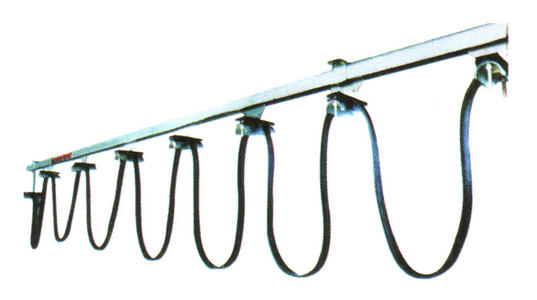
Current collector is a sliding wire
The current collector is one of the most important components in the sliding wire system.
The current collector is the main device for picking up electrical energy on the collector side in the sliding contact line system. It directly conducts electrical energy to the electrical appliance through the sliding contact between the collector brush and the guide rail, thereby achieving mobile power supply for the system. The current collector consists of two parts: a mechanical tension device and a collector brush that directly slides in contact with the guide rail.
The mechanical tension device determines the sliding contact pressure between the collector brush and the guide rail and the stability of the mechanism. The collector brush is the conductor that slides in contact with the guide rail to pick up electrical energy. Its performance, conductive quality, and the quality of the material structure and composition will directly affect the safe operation quality of the entire system equipment.
Types
There are many types of current collectors. Commonly used in testing are: pull-wire type, brush type, and inductive type, etc. The first two are contact-type current collectors, while the latter is a non-contact type current collector.
Pull-wire type current collector
The structural principle of the pull-wire type current collector is shown in the right figure.
Pull-wire type current collector
A bakelite inner ring 2 is fixed on the circular shaft 1, and a collector ring 3 is embedded in its groove, which is connected to the strain gauge attached to the shaft. In this way, electrical signals are transmitted from the collector ring 3, pull wire 4, insulating plate 5, and terminal 6 to the measuring instrument. The pull wire 4 is tensioned by a spring 7 to ensure good contact with the collector ring.
This type of current collector is suitable for situations with relatively low linear speed (≤4 m/s) and short operation time. Its advantages are simple structure, low process requirements, and reliable contact, but it has high wear and low lifespan.
Brush type current collector
Brush type current collectors can be divided into radial brush type and face brush type. Radial brush type
Brush type current collector
The radial brush type contacts the brush with the circumferential surface of the collector ring, while the face brush type contacts the brush with the side surface of the collector ring. The structural principle is shown in the right figure. The inner ring 1 of the
current collector is fixed on the rotating shaft to be measured, and it has three (for half-bridge measurement) or four (for full-bridge measurement) collector rings 3, which are insulated from each other and from the inner ring, and are connected to the strain gauge attached to the shaft with wires. The housing is fixed with mutually insulated brushes 2, which are pressed against the collector rings by springs 4, and each brush has a lead wire. In this way, the electrical signals on the rotating shaft are transmitted to the measuring instrument through the contact between the collector rings and the brushes.
The radial brush type current collector has a simple structure and is easy to use, but the contact resistance is not very stable, so it is only suitable for situations with low speed and not very high precision requirements. The face brush type current collector relies on side contact, and the contact resistance is relatively stable, making it suitable for situations with higher speed and high precision requirements.
When designing a current collector, the following points should be noted:
① The materials of the collector rings and brushes should be selected appropriately to ensure low contact resistance and low friction coefficient. For general current collectors, the collector rings can be made of red copper, and the brushes can be made of graphite-copper alloy. For current collectors with high measurement precision, it is best to use pure silver or Monel alloy for the collector rings, and graphite-silver alloy for the brushes.
② The number of brushes on each collector ring affects the magnitude and stability of contact resistance. Too few brushes may cause unreliable operation, while too many may complicate the structure. Generally, it is appropriate to arrange 2 to 4 brushes symmetrically.
③ The contact pressure between the brushes and the collector rings also affects the magnitude and stability of contact resistance. If the pressure is too low, the contact resistance is large and unstable; if too high, it can cause wear, heating, and reduce lifespan. Generally, the pressure should be between 60-80
is appropriate.
④ The pressure springs of each brush on the same collector ring should preferably have different natural frequencies to ensure that during strong vibration, not all brushes lift off at the same time, maintaining good contact.
Inductive type current collector
The inductive type current collector is also called a rotary transformer type or non-contact type current collector. Its working principle is to use electromagnetic induction to transmit the measurement electrical signals from the rotating part to the fixed part, eliminating various contact points, so there are no problems such as contact resistance.
Inductive type current collector
The electrical schematic and structure of this type of current collector are shown in the right figure. The four strain gauges attached to the measured shaft are connected in a full-bridge circuit; the bridge supply voltage of the strain gauge