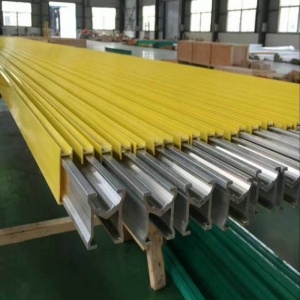
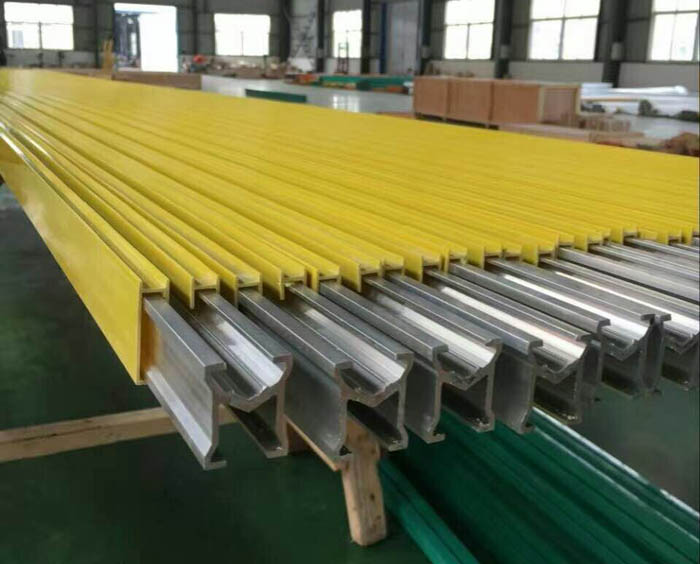
HXPnP, R-H type protective safety sliding contact line, its conductive main body is an aluminum profile with an "H" cross-section, hence it is also called "H" type energy-saving sliding wire device. Energy saving is relative to the sliding contact line mainly made of angle steel, and the loss of electrical energy during transmission is greatly reduced. The resistivity of aluminum is much lower than that of steel, and its specific gravity is small. Rolling aluminum into an "H" shape is to improve overall rigidity and strength on the basis of ensuring a certain conductive cross-sectional area. However, the surface hardness of aluminum is low and it is not wear-resistant. In order to make the aluminum substrate meet the practicality of being a conductive sliding contact line, the "H" shaped middle beam is made into an arched shape, and wear-resistant stainless steel profiles are embedded here according to the specified process. This "H" shaped stainless steel profile serves as the friction and current transmission surface for the conductive block in the current collector. Its embedding process ensures the tight combination of stainless steel and aluminum profile, so that the current introduced from the aluminum profile passes through the stainless steel body, and the conductive block in the current collector that maintains contact with it transmits the current out during friction contact, ensuring the continuity of current during the operation of lifting machinery.
The conductive sliding line is protected along the longitudinal direction of the sliding line with ABS plastic as a whole, except for the lower opening where it contacts the current collector. Therefore, after installation, the contact line has no exposed conductive parts, which brings great convenience to installation and maintenance. At the same time, the overall plastic shell protection (except for the opening) prevents dust accumulation and provides protection against rain, dew, ice, and snow. The connection between guide rails is a dedicated rail connector that allows both the rail and the plastic shell to extend into it, and the connection end is also safe and reliable.