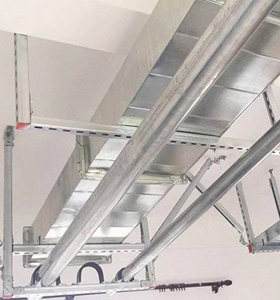

Design and Application of Seismic Support and Hanger Systems
Technical Basis of Seismic Supports
l The seismic support system for building electromechanical engineering is designed and installed based on comprehensive analysis according to relevant standards, considering the seismic fortification intensity, building usage function, building height, structural type, deformation characteristics, location of auxiliary equipment, and operational requirements.
l In the seismic support system for building electromechanical engineering, important equipment rooms should not be located in areas that may cause secondary disasters such as functional impairment; for equipment with vibration isolation devices, and where strong vibrations affect connecting components, consideration should also be given to preventing resonance between equipment and building structures, with comprehensive consideration and design.
l The supports and hangers designed and manufactured for the seismic support system of building electromechanical engineering should have sufficient stiffness and load-bearing capacity; they should have reliable connections and anchorage with the building structure, enabling equipment to quickly resume operation after experiencing an earthquake of the design fortification intensity.
l In the seismic support system for building electromechanical engineering, openings for pipes passing through structural walls should be arranged to minimize weakening of main load-bearing structural components. Connections between pipes, equipment, and the building structure should allow for a certain relative displacement between them.
l The base or connecting components of the seismic support system for building electromechanical engineering have the function of transmitting all seismic forces borne by equipment to the building structure. In the structure, the parts used to fix embedded parts and anchoring components of the seismic support system should be strengthened during design and construction to withstand the seismic forces transmitted from the auxiliary electromechanical engineering facilities to the main structure.
Three mandatory provisions in "GB50981-2014 Code for Seismic Design of Building Electromechanical Engineering":
1. Building electromechanical engineering in areas with seismic fortification intensity of 6 degrees and above must undergo seismic design (1.0.4)
2. Smoke exhaust ducts, emergency ventilation ducts, and related equipment should use seismic supports and hangers (5.1.4)
3. Public antennas installed on building roofs should take safety protection measures to prevent equipment or components from falling and causing injury after an earthquake (7.4.6)
Scope requiring seismic design:
1. Equipment in suspended pipelines with gravity greater than 1.8KN (183kg) (3.1.6)
2. Gas pipelines with inner diameter greater than or equal to 25mm, indoor water supply, hot water, and fire protection pipelines with diameter greater than or equal to DN65 (4.1.2, 6.1.1)
3. Duct systems with rectangular cross-sectional area greater than or equal to 0.38㎡ and circular diameter greater than or equal to 0.7m (5.1.3)
4. Electrical conduits with inner diameter greater than or equal to 60mm and cable trays, cable troughs, and busways with gravity greater than or equal to 150N/m (15kg/m) (7.1.2)
Maximum Spacing of Seismic Supports and Hangers