
, we can explore from multiple perspectives, including their functions, application scenarios, advantages and disadvantages, etc. The following is a detailed article outline and content:
Title
Cable Tray vs. Busway: Choosing the Most Suitable Power Transmission Solution for You
Introduction
In modern buildings and industrial facilities, the reliability of power transmission systems is crucial. Cable trays and busways are both important components used for power transmission, but they each have unique characteristics and applicable scenarios. This article aims to help readers better understand the differences between these two systems through a comparative analysis, and choose the most suitable solution for specific needs.
Overview of Cable Tray
A cable tray is an open cable support system, mainly composed of a metal frame, used to support and protect wires and cables. It is commonly used in commercial buildings, data centers, industrial plants, and other places.
Advantages:
Easy to install and maintain;
Flexible expansion;
Relatively low cost;
Good heat dissipation.
Disadvantages:
For large current transmission, the number of cables may be large and installation complex;
Occupies more space;
In some cases, cable connection and management may become complex.
Overview of Busway
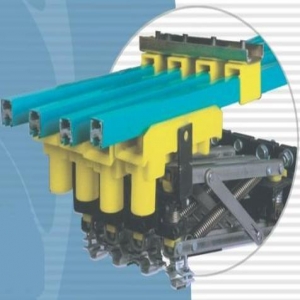
A busway is a closed conductive path system, composed of multiple conductors embedded in a metal shell, mainly used for large current power distribution inside buildings.
Advantages:
Strong large current transmission capability;
Superior heat dissipation performance;
High space utilization;
Higher safety due to closed design.
Disadvantages:
Higher initial investment cost;
Poor expandability, not easy to modify once installed;
Strict installation requirements, requiring professional technicians.
Application Scenario Comparison
Cable tray: Suitable for applications that require frequent changes in wiring layout or have smaller cable capacity, such as office buildings, schools, etc.
Busway: More suitable for occasions that require stable power supply and large current, such as industrial plants, large shopping malls, high-rise buildings, etc.
Technical Indicator Comparison
Load capacity: Busway can carry larger current loads.
Installation complexity: Cable tray installation is relatively simple and quick; busway requires a more complex installation process.
Maintenance convenience: Cable tray is easy to maintain, while busway is more complex to maintain due to its closed design.
Selection Suggestions
For small projects or situations where current demand is not large and may change in the future, it is recommended to choose cable tray.
For projects with large current transmission, limited space, and need for long-term stable power supply, busway should be given priority.
Conclusion
Cable tray and busway each have their own merits; the choice depends on specific application needs. By understanding and comparing the characteristics of both, engineers and project managers can make more informed decisions to ensure efficient and safe operation of power transmission systems.
Through the above analysis, readers can have a comprehensive understanding of cable tray and busway, and make appropriate choices based on actual conditions. If more detailed discussion is needed for specific application cases, further research on relevant technical specifications and standards can be conducted.