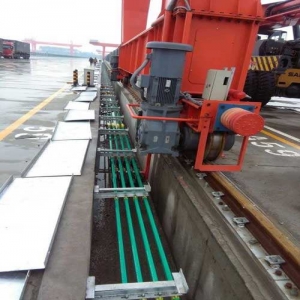

They each have different application scenarios and characteristics.
Cable Tray
A cable tray is a system used to support cables, typically made of metal such as steel or aluminum, to support power cables, control cables, and other types of cables. Cable trays can be open trays (also called ladder trays), enclosed troughs, or other forms, and different types of trays are selected based on the usage environment.
The main advantages of cable trays include:
Easy installation, easy expansion and maintenance.
Can accommodate a large number of cables and manage them well.
Provides good physical protection to prevent cables from mechanical damage.
In some cases, cable trays can also provide a certain degree of fire protection.
Busway
Busway is a power distribution system commonly used in commercial and industrial buildings. It consists of conductors wrapped in insulating material, fixed within a metal enclosure. Busways can be designed in straight sections, elbows, T-joints, and other shapes to meet different installation needs.
The main advantages of busway include:
Faster installation than cables because it is prefabricated, reducing on-site connection work.
High current density, suitable for high-power demand applications.
Lower energy loss because busways typically have larger cross-sectional areas.
Better heat dissipation performance, helping to improve system safety.
Comparison between the two
Application scope: Cable trays are typically used in situations requiring a large number of cables, while busways are more suitable for high-load power transmission.
Cost: Cable trays may have lower initial installation costs, but costs increase as the number of cables grows; in contrast, busways have higher initial investment but may be more economical in long-distance and high-current applications.
Maintenance: Cables in cable trays can be replaced individually, while if a busway has issues, the entire section may need to be replaced.
Installation flexibility: Cable trays offer more installation flexibility, while busways provide better current transmission efficiency.
When choosing between cable tray and busway, factors such as project-specific requirements, current demand, space constraints, cost budget, and future expansion possibilities should be considered.