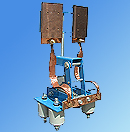

HXDL-40 New Type Guide Rail Trolley Detailed Information
New Type Guide Rail Trolley
Classification and uses of guide rail trolleys: 1. A simple lifting device for vertically hoisting heavy objects. It is lightweight and compact in structure. There are manual and electric types. ①Manual trolley: Pulled by manpower via a traction chain, which drives a chain drum through a worm gear to lift or lower the load. It uses a load self-locking brake, where the heavier the load, the greater the braking torque, ensuring safety and reliability. The working range is a vertical line below the hook. Nylon wheel aluminum plate lifting trolley: HXDL-40 guide rail trolley. Uses: Suitable for lifting poles, stringing wires, hoisting equipment, and live-line work. Features: Lightweight, durable wheels that do not damage wire ropes or cords. Available in hook type, ring type, single opening, and double opening. ②Electric trolley: Driven by an electric motor through a gear transmission mechanism, wire rope drum, and hook pulley to lift or lower the load. The housing contains the wire rope drum, connected to the motor and the gear transmission with brake. The upper part of the middle housing has a lifting lug. After hanging, it can vertically lift loads. It can also be mounted on a running trolley to become a traveling load trolley, moving along overhead tracks to transport materials within or between workshops. 2. Trolleys are classified by the number of wheels into single-sheave, double-sheave, and multi-sheave trolleys. By the connection method with the load, they are divided into hook-type, chain-type, ring-type, and suspension-frame-type trolleys. Generally, small and medium trolleys are hook-type, chain-type, or ring-type, while large trolleys use ring-type or beam-type. By the contact between wheel and axle, they are divided into those with sliding bearings and those with rolling bearings. By whether the side plates can be opened, there are open and closed trolleys. Open trolleys have side plates that can be opened for easy rope installation; they are usually single-sheave and often used as guide pulleys at the base of derricks. Trolleys are also divided into fixed and movable types based on usage. The HXDL-40 guide rail trolley is convenient to use, widely applicable, and can be operated manually or mechanically. It can change the direction of the traction rope of the trolley and trolley group multiple times and lift or move heavy objects. Especially, trolley groups combined with winches, masts, or other lifting equipment are widely used in construction and installation operations. Mainly used in factories, mines, agriculture, electric power, construction production and construction, docks, shipyards, warehouses for machine installation, cargo lifting, etc.
The HXDL-40 guide rail trolley also features fully sealed bearings for its traveling wheels, and the cable clamping part uses an arc-shaped soft rubber pad to prevent cable damage. The first car and intermediate cable-carrying trolleys are equipped with anti-collision buffers to ensure the trolleys are not impacted during starting and stopping.
New Type Guide Rail Trolley
1. Contact wires (for electric locomotive overhead lines, gantry cranes, hoists, traveling copper slide wires, busbars), commonly known as trolley wires:
1. Copper contact wires for trolley (also known as double-groove copper wire, bare copper wire): CT series (CT85, CT110, CT120, CT150, CT185, CT200, CT220, CT250). Made of oxygen-free copper, featuring high conductivity and high strength.
2. Copper alloy trolley wires: Copper-silver alloy CTAH series (CTAH85, CTAH110, CTAH120, CTAH150, CTAH185),
Copper-magnesium alloy CTMH series (CTMH110, CTMH120, CTMH150);
3. Internally clad steel-aluminum composite trolley wires: GLCN series (GLCN195, GLCN250);
4. Externally exposed steel-aluminum composite trolley wires: CGLW series (CGLW100, CGLW173, CGLW215);
5. Steel-core aluminum alloy composite trolley wires: CGLHD series (CGLHD195, CGLHD260, CGLHJ260);
6. Aluminum alloy trolley wires: CLHA series (CLHA 130, CLHA 170, CLHA 200);
7. Copper trolley slide wires: Ф6mm------Ф30mm;
8. Double-groove copper slide wires: 35mm2------185mm2;
9. Safety busbar trunking systems
2. Suspension fittings (also known as hanger tighteners or hangers):
1. Collector assemblies (current collectors), collector heads, carbon sliders, copper connection rods, copper-aluminum transition for trolley wires (SLT-1, SLT-2), disc-type copper feeder clamps;
2. Chain suspension assemblies, rigid suspension assemblies, armored hangers, curve hangers (WX-001), phenolic hangers (AK-1);
3. Suspension insulators (CD-1, WX-1), rigid insulators (WX-02), pin-type insulators for trolley wires (P-6-10-15), chain suspension insulators, rigid clamps (120mm, 150mm, 300mm), wire pullers (XK-1), hanger plates;
4. Single wire clamps (DXK-1, DXT-1), double wire clamps (DXK-2, BXT-2), parallel groove clamps (BJK-1, BJK-2, BJK-1, BJT-2, BJKT-1), clevis clamps (KH-1), aluminum feeder clamps (KDL-1), copper feeder clamps (KDT-1), jumper clamps (DA-1), terminal clamps (ZD-1-2-3), dropper clamps (DJ-1), crimp tube single wire clamps, crimp plate single wire clamps, chain suspension clamps, steel wire rope clips (12mm-15mm);
5. Section switches (HHP1-200, HHP1-200-600), section insulators for trolley wires (F-1, F-2), insulators (J-1, J-2, J-4.5), insulated fishplates, terminal adjustment hooks (TJ-12, TJ-16), horizontal suspension hooks, single catenary arms, double catenary arms