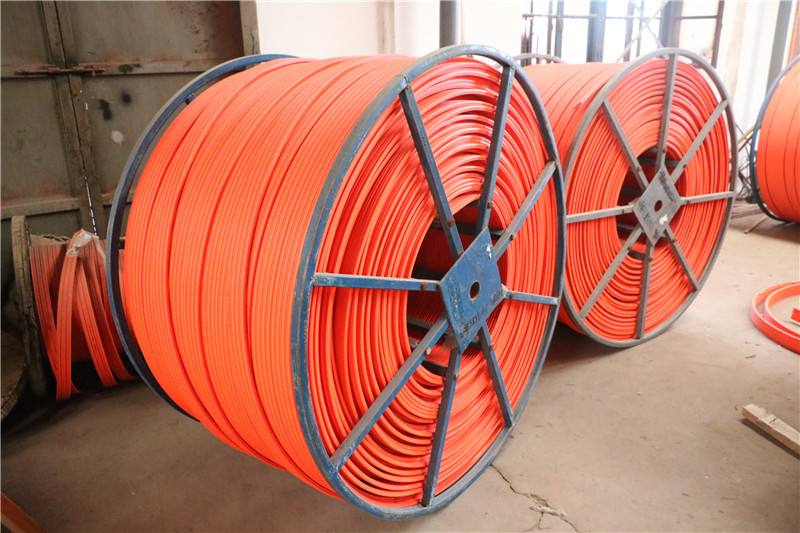

Introduction to Seamless Sliding Contact Lines
Seamless sliding contact lines, produced with advanced technology, are available in 3-pole, 4-pole, and 6-pole versions. They feature no power interruption, use oxygen-free copper for power transmission, have low voltage drop, excellent conductivity, good contact, easy installation, resistance to wear, convenient replacement, and easier transportation, which reduces the risk of damage to the contact line and extends its service life.
Features of sliding contact lines:
Safe, stable, no joints (except at power supply points), compact size, easy installation, and economical;
Seamless sliding contact lines are installed without joints, making installation simple and time-saving, and requiring minimal space;
Made of special materials, seamless sliding contact lines operate smoothly, at high speeds, and with low noise;
The minimum bending radius for seamless sliding contact lines is 750mm.
Precautions for using sliding contact lines:
When 3-pole, 4-pole, and 6-pole sliding lines have curves, side installation must be adopted;
Starting from the beginning of the turn, a sliding line clamp should be installed every 0.5 meters;
The end power tensioner for 3-pole, 4-pole, and 6-pole lines must be installed about 5mm higher than the sliding line clamps;
3-pole, 4-pole, and 6-pole sliding lines are not suitable for outdoor use or in environments with high acid or alkali content.
Maintenance of sliding contact lines:
To ensure normal operation and extend the service life of sliding contact lines, regular inspections should be conducted after they are put into operation.
1) Carbon brushes: Check every 1-3 months according to the usage of the mobile equipment. Focus on the wear of the collector carbon brushes; if the wear is ≥5mm, they must be replaced. If the brushes are found loose or worn unevenly during inspection, identify the cause and handle it promptly.
2) Current collectors: Check at least once per quarter. Focus on whether fasteners are loose or displaced, and the wear of plastic parts and moving parts. Check the spring tension (the contact pressure between the collector brush and the guide rail should be maintained at a certain level). If any issues are found, handle them promptly.
3) Connectors: Check at least once per year. Focus on whether fastening bolts, welds, and support parts are loose, corroded, or displaced. If any issues are found, handle them promptly.
4) Daily inspections: Focus on checking whether the straightness of the track has obvious deviations (greater than 20mm) or misalignment, whether insulation protective parts have fallen off, cracked, or broken, whether the stainless steel "V" groove is warped, and whether there are foreign objects or conductive dust on the track. If necessary, check whether the insulation resistance meets the requirements (phase-to-phase insulation resistance should be ≥5MΩ).