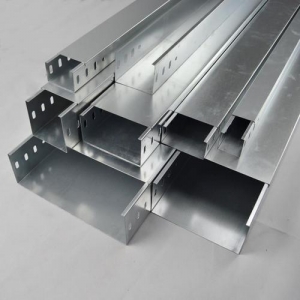

Among various coating methods for protecting steel substrates, hot-dip galvanizing is an excellent one. It involves immersing the steel in molten zinc at a liquid state, undergoing complex physical and chemical reactions, resulting in not only a thick pure zinc layer but also a zinc-iron alloy layer on the steel. This method not only possesses the corrosion resistance of electroplated zinc but also, due to the presence of the zinc-iron alloy layer, offers superior corrosion resistance that electroplating cannot match. Therefore, this method is particularly suitable for environments with strong acids, alkali fumes, and other highly corrosive conditions.
Definition
Hot-dip galvanized cable tray involves immersing derusted steel components into molten zinc at around 600°C, allowing a zinc layer to adhere to the steel surface. The thickness of the zinc layer must not be less than 65μm for sheets thinner than 5mm, and not less than 86μm for thicker plates, thereby achieving corrosion protection. As an effective metal anti-corrosion method, hot-dip galvanizing has been widely used in metal structures across various industries, with corrosion resistance lasting over 10 years.
Principle
The hot-dip zinc layer is formed in three steps under high-temperature liquid zinc:
1. The iron-based surface is dissolved by the molten zinc to form a zinc-iron alloy phase layer.
2. Zinc ions in the alloy layer further diffuse into the substrate to form a zinc-iron interdiffusion layer.
3. The surface of the alloy layer is enveloped by the zinc layer.
Advantages ofHot-Dip GalvanizedCable Tray: It has excellent anti-corrosion performance, long durability, much longer lifespan than ordinary trays, high industrialization, and stable quality. Hence, it is widely used in outdoor environments where atmospheric corrosion is severe and maintenance is difficult.
Performance Characteristics
(1) It has a thick, dense pure zinc layer covering the steel surface, which can prevent the steel substrate from contacting any corrosive solution, protecting the steel substrate from corrosion. In general atmospheres, a thin and compact zinc oxide layer forms on the zinc surface, which is hardly soluble in water, thus providing certain protection to the steel substrate. If zinc oxide reacts with other components in the atmosphere to form insoluble zinc salts, the anti-corrosion effect is even better.
(2) It has a zinc-iron alloy layer with dense bonding, exhibiting unique corrosion resistance in marine salt spray atmospheres and industrial atmospheres.
(3) Due to strong bonding and zinc-iron interdiffusion, it has high wear resistance.
(4) Due to zinc's good ductility and the firm adhesion of the alloy layer to the steel substrate, hot-dip galvanized parts can undergo cold stamping, rolling, wire drawing, bending, and other forming processes without damaging the coating.
(5) After hot-dip galvanizing, steel structural parts undergo an annealing-like treatment, effectively improving the mechanical properties of the steel substrate, relieving stress from forming and welding, and facilitating machining of steel structural parts.
(6) The surface of hot-dip galvanized parts is bright and aesthetically pleasing.
(7) The pure zinc layer is the most ductile layer in hot-dip galvanizing, with properties close to pure zinc, possessing ductility, hence it is flexible.